
Benchmarks
Resid was measured against C, C++, Rust, Go, Java, C#, JavaScript, Python,
Fortran and Pascal on the ten programs of the
Computer Language Benchmarks Game,
at the official problem sizes. The full generated report, with every run,
confidence intervals, build commands and per-program notes, is
docs/BENCHMARKS.md;
the suite is in bench/suite.
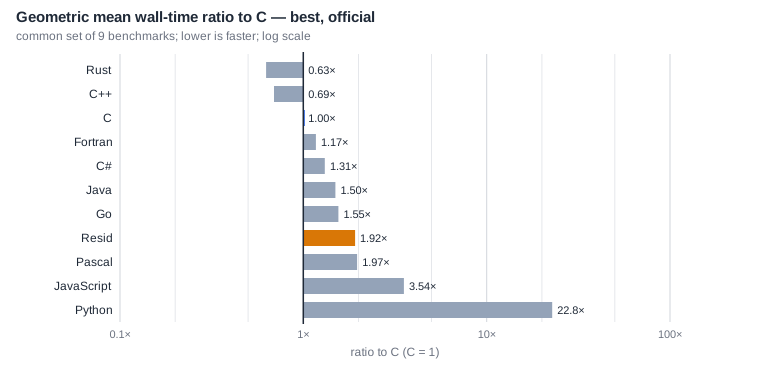
In one line: written the same way as the C program, Resid is the fastest of the eleven languages overall (0.93× C) and uses the least memory (0.73× C); against each language’s fastest hand-tuned program it is 0.71× C, level with C++ and behind Rust (0.62×).
How it was measured
Section titled “How it was measured”- Two tracks.
st: every language implements the same algorithm, single-threaded, no SIMD or-march=native, pinned to one core.best: the fastest known program per language (Benchmarks Game, 3-clause BSD); threads, SIMD and-O3 -march=nativeallowed. Resid’sbestprograms are itsstprograms made parallel withspawn, several using vector types (Vec(T, N)) for SIMD. - Timing. Wall-clock median of 5 cold process runs (fewer for runs
over 60 s), CPU time and peak RSS from
wait4. Every output is checked byte for byte against the C program’s; every run passed. - Aggregation. Each result is divided by C’s for the same track, and languages are ranked by the geometric mean of those ratios (C = 1.00).
- Machine. AMD Ryzen AI 7 PRO 350 (8 cores, 16 threads, mixed core types), 54.6 GiB, Linux 7.2, performance governor. gcc 16.2, clang 22.1, rustc 1.98, Go 1.27, .NET 10.
regex-reduxis not applicable to Resid: it has no regular-expression library, and writing one for the benchmark would measure that engine. The means below are over the other nine programs.
Overall
Section titled “Overall”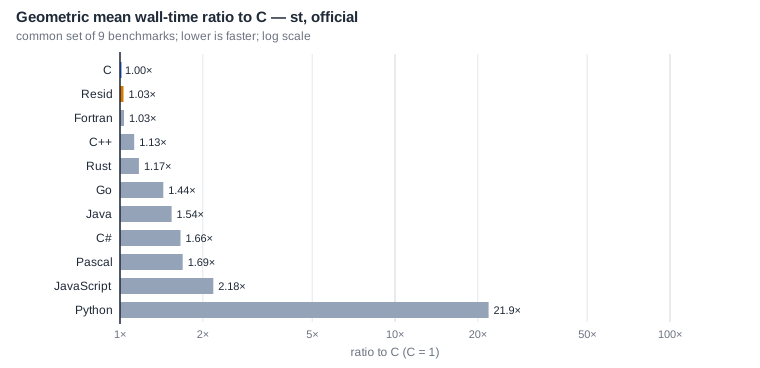
| Language | st time (× C) |
best time (× C) |
st memory (× C) |
best memory (× C) |
|---|---|---|---|---|
| Resid | 0.93 | 0.71 | 0.73 | 3.93 |
| C | 1.00 | 1.00 | 1.00 | 1.00 |
| Fortran | 1.04 | 1.21 | 1.90 | 2.16 |
| C++ | 1.15 | 0.71 | 2.00 | 1.69 |
| Rust | 1.20 | 0.62 | 1.49 | 1.16 |
| Go | 1.47 | 1.54 | 1.98 | 2.19 |
| Java | 1.57 | 1.57 | 11.9 | 12.3 |
| C# | 1.70 | 1.31 | 8.30 | 5.65 |
| Pascal | 1.74 | 1.94 | 0.85 | 1.23 |
| JavaScript | 2.26 | 3.58 | 15.7 | 20.8 |
| Python | 22.4 | 23.5 | 4.30 | 4.51 |
Resid against C, program by program
Section titled “Resid against C, program by program”Wall-time ratio to C (below 1.00, Resid is faster):
| Program | st |
best |
What decides it |
|---|---|---|---|
binary-trees |
0.34 | 0.21 | allocation: see below |
fannkuch-redux |
0.58 | 0.46 | a packed permutation; byte shuffles in best |
nbody |
0.77 | 1.07 | the sqrt builtin; vector pair distances in best |
fasta |
0.95 | 0.26 | a lookup table and a jump-ahead generator in best |
mandelbrot |
1.02 | 0.77 | 32 pixels in four Vec(Float, 8) in best |
pidigits |
1.09 | 1.17 | exact decimals against GMP |
k-nucleotide |
1.14 | 1.25 | Resid’s hash map against hand-written tables |
spectral-norm |
1.44 | 0.62 | one row at a time in st; 8 rows per pass, vectorized, in best |
reverse-complement |
2.01 | 2.44 | a byte-at-a-time loop against C’s bulk in-place reversal |
Where Resid is strong
Section titled “Where Resid is strong”- Straight-line compiled code. With the same algorithm, Resid is at or ahead of C speed on most programs, and first of the eleven overall: it compiles through LLVM to a static binary with no runtime start-up, garbage collector or JIT.
- Allocation-heavy code.
binary-treesallocates and discards hundreds of millions of tree nodes. Resid releases each short-lived tree in one step at the end of the binding that built it (the compiler proves nothing else can see it), where C callsmallocandfreeper node. It beats every language on thesttrack and the C, Go, C#, Java and JavaScriptbestprograms. - Memory. On the
sttrack Resid uses 0.73× C’s memory, the least of all eleven. Values are unboxed and updated in place when the compiler proves they are unshared. spawnscales. Regions run on a pool of reused threads (a spawn costs under a microsecond). Thebestprograms are thestprograms withspawn: fannkuch-redux 15.2 s → 0.98 s, binary-trees 2.3 s → 0.56 s, spectral-norm 1.12 s → 0.054 s (the fastest of all languages), fasta 2.3 s → 0.14 s (the fastest by 3.6×).
Where Resid is weak
Section titled “Where Resid is weak”- SIMD on par, not ahead. With vector types, mandelbrot, fannkuch-redux
and nbody
bestare within 0–10% of the fastest C++ and Rust programs, not ahead of them. - Byte-at-a-time text.
reverse-complementbuilds 250 MB of output one character at a time. The builder lives in registers and each read is a bounds test and a load, but C reverses the buffer in place with bulk operations; Resid is 2.0× C onstand 2.4× onbest. - Memory on the
besttrack. Parallel Resid programs keep a heap per worker and build their outputs as lists and strings, so peak memory rises with parallelism (3.9× C, below Python, C#, Java and JavaScript). - Hashing.
k-nucleotideuses Resid’s generalMap; the fastest programs use specialized tables. - Binaries. Resid executables are static and 20–70 KB against C’s 16 KB dynamically linked ones; building one takes about 1.8 s (most of it clang).
Read with care
Section titled “Read with care”fannkuch-reduxst. Resid has no mutable arrays, so its program packs the permutation 4 bits per element into one integer and flips a prefix with shifts and masks in constant time instead of swapping element by element. The algorithm (which permutations, in which order, how flips are counted) is the benchmark’s, but the representation is unusual, and the 0.58× owes much to it.- Vector programs. The
bestspectral-norm, mandelbrot, nbody and fannkuch-redux programs keep every floating-point operation in the reference’s order, so their output is byte-identical; thestprograms use no vector types and no loop restructuring beyond the reference. - Target. Resid binaries on both tracks target x86-64 with SSSE3,
SSE4.1 and AES-NI (its runtime needs them); the other languages’
stbuilds use the plain x86-64 baseline. binary-trees. Resid’s win comes from its memory model (a short-lived tree is released as a whole), not from faster per-node code; a C program using an arena allocator would close the gap, and the Benchmarks Game’s C++ and Rustbestprograms do.pidigitshas no bignum type in Resid: it uses exactDec(N)decimals, compared with GMP in C.- One machine, cold process runs, frequency boost enabled, background load not stopped. The per-run spread is in the full report.
- Program quality differs:
bestprograms come from different authors with different tuning effort; the Resid programs were written for this suite.
Reproducing
Section titled “Reproducing”cd bench/suite./bench.py env && ./bench.py build && ./bench.py inputs./bench.py run --size official # about 2.5 hours on the machine above./bench.py report # docs/BENCHMARKS.md and docs/benchmarks/./bench.py run --size small takes a few minutes.